Where Did it Go?
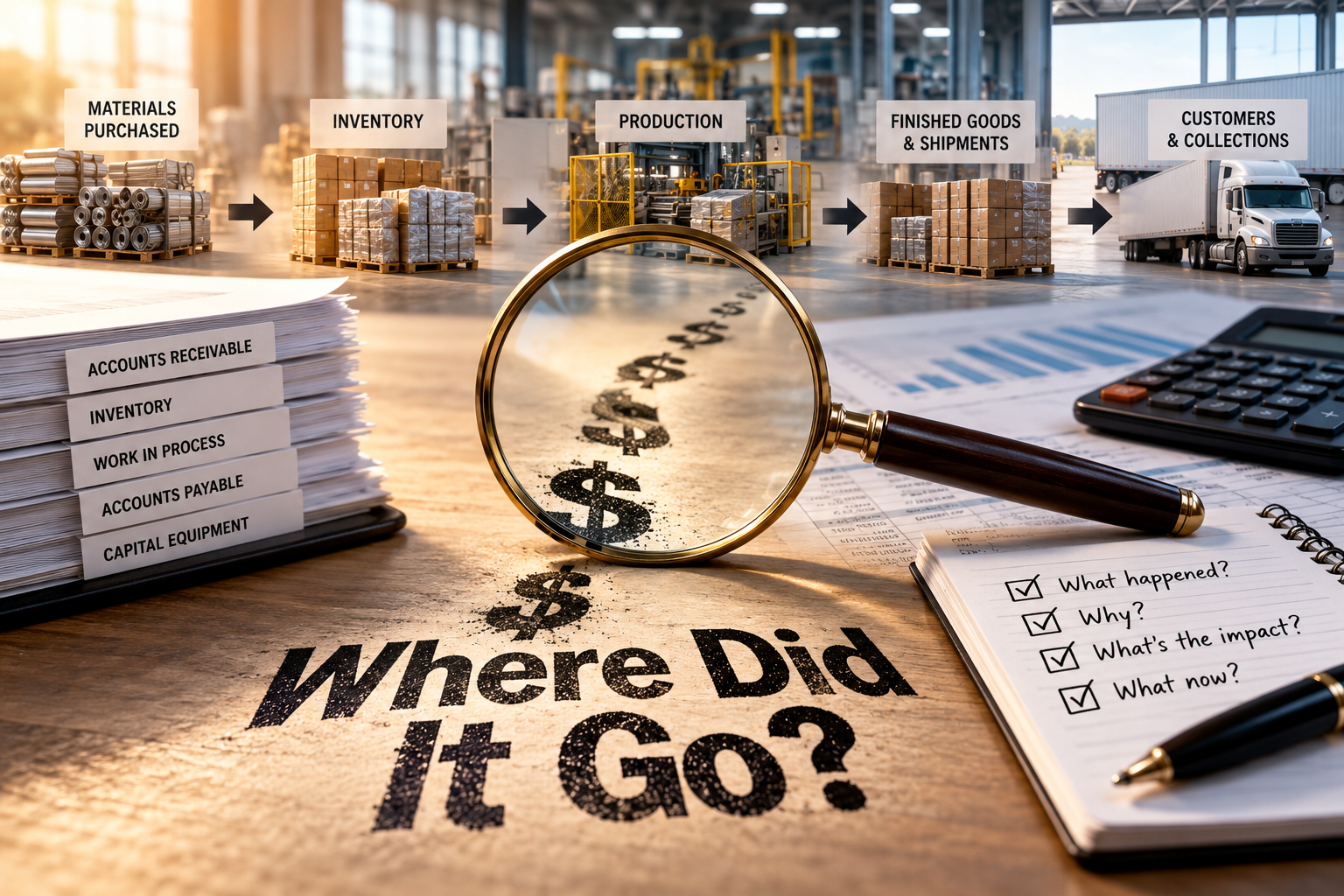
Cash doesn't destroy businesses. Decisions do.
I've been in more meetings than I care to remember where the conversation eventually turned to the same uncomfortable subject: "We don't have enough cash to cover everything that's coming due."
Payroll is approaching, vendors are expecting payment, and the bank has its own schedule. Everyone knows what needs to be paid. The problem is that the available cash and the obligations aren't even close.
That's usually when the suggestions start. Can we increase the line of credit? Stretch vendor payments until collections improve? Postpone planned expenditures? In more difficult situations, someone inevitably raises the possibility of reducing headcount.
Sometimes those measures are necessary. But before deciding how to respond, I've always wanted to answer another question.
Where did it go?
The business hasn't stopped operating. Customers are placing orders, employees are working, materials are arriving, and products are being manufactured. Yet the cash we expected to have available isn't there.
It didn't simply disappear. Somewhere along the way, decisions were made that affected how much cash was available and when.
The challenge is understanding which decisions were made, why they were made, and what happened as a result.
Follow the Money
My investigation usually begins with the financial information. The bank reconciliation establishes our current cash position. The forecast shows what we expected to receive and pay. The financial statements help identify where things have changed.
Each provides clues, but none tells the entire story.
One of the realities of manufacturing is that profitability and cash flow don't always move together. A business can report a profitable month and still struggle to meet its obligations. Sales may be increasing, but additional business can also require more inventory, more production costs, and more time before customers pay.
That's why I look beyond the income statement.
If accounts receivable increased, is it because sales grew, customers received extended payment terms, or collections slowed? If inventory increased, was that intentional, or are materials accumulating faster than production can use them? If work-in-process is growing while shipments remain flat, what's preventing those products from being completed?
The financial statements help narrow the possibilities. But understanding what caused those changes often requires getting away from the desk and into the business.
The Clues Aren't Always in the Numbers
Throughout my career, I've made a habit of walking through manufacturing facilities, talking with people, and paying attention to what's happening around me.
Sometimes I'd notice raw materials arriving more frequently than expected. Other times, I'd see a new piece of equipment being installed without having seen the purchase paperwork. I can even remember noticing that fuel trucks seemed to be showing up more often.
None of those observations necessarily meant something was wrong. But they made me curious.
Why were we receiving more material? Had Purchasing negotiated a favorable price, or were we preparing for an increase in demand? Was the new equipment part of an approved capital plan, and how were we paying for it? Were the additional fuel deliveries caused by increased consumption, higher production activity, or a change in purchasing arrangements?
The answers weren't always obvious, and the financial consequences weren't always immediate.
Consider inventory. Purchasing might buy additional material to protect against supplier shortages or anticipated price increases. That could be a sound business decision. But depending on payment terms, production schedules, and customer demand, the additional inventory could affect cash for weeks or months.
The same applies to work-in-process. An increase might reflect higher production volume, a scheduling change, a quality issue, or a delay in completing customer orders. Each possibility affects how quickly the investment in materials and labor moves through production and eventually becomes a customer payment.
That's why I've always believed in pulling the thread until the story makes sense.
The numbers tell me where to start looking. What I learn from the people making the decisions helps me understand what actually happened.
The Decisions Behind the Numbers
One thing I've learned over the years is that cash doesn't make decisions. People do.
Cash doesn't negotiate supplier pricing, approve customer discounts, or decide how much inventory to purchase. It doesn't determine production schedules or authorize capital investments.
People throughout the business make those decisions, usually with good intentions and sound reasons.
Purchasing wants to keep materials available and control costs. Sales wants to win business and maintain customer relationships. Engineering looks for ways to improve products and processes. Operations works to keep production moving and meet delivery commitments.
Each department has legitimate responsibilities, and decisions that make sense within one department can have consequences elsewhere in the business.
Purchasing may decide to build inventory ahead of a supplier price increase. Sales may negotiate extended payment terms with an important customer. Meanwhile, a production issue may delay shipments.
Individually, those decisions and circumstances may be entirely reasonable. Together, they can change the amount of cash available and the timing of when additional cash comes in.
And the effects don't necessarily occur at the same time. Material might be received today but paid for next month. Production costs accumulate as work progresses. Customer payments may arrive weeks after the finished product ships.
By the time a shortage becomes apparent, the decisions affecting it were often made months earlier.
A decision that creates a cash requirement isn't necessarily a bad decision. Sometimes investing in inventory, equipment, or customer relationships is exactly what the business needs.
The problem arises when the financial consequences aren't understood or anticipated.
Finding the Cash Is Only Half the Answer
Once I've identified where the cash went, the next question is why.
The same change on a balance sheet can have several explanations, and each calls for a completely different response. That's why I don't believe there's a single formula for resolving cash shortages. Every business has its own customers, suppliers, operating requirements, and financial commitments.
Experience helps me recognize patterns and know which questions to ask, but it doesn't replace understanding the facts.
Sometimes the investigation confirms that the business made the right decisions. What needs to change is how those decisions are communicated, incorporated into forecasts, and considered alongside other commitments.
Finance can forecast the information it receives. It can't anticipate every purchasing commitment, customer arrangement, production change, or capital investment that hasn't been communicated.
I don't believe Finance needs to approve every decision. Department leaders need the authority to manage their responsibilities. But understanding the financial consequences of those decisions is a company-wide responsibility.
The problem isn't necessarily the decision. It's when the decision never leaves the department where it was made.
Back to That Meeting
Now we know where the cash went, why it went there, and what we need to do about it.
We may still need that line of credit or some flexibility with our vendors, but at least we're making those decisions with an understanding of what brought us here.
Finance reports cash. Decisions create it.
Jeff Janssen, CPA
Janssen Strategic Advisor, LLC